Research on behavior and system change
The University of Groningen (UG) is an international university that focuses on all disciplines of science and technology. The UG is well-established within the Northern Netherlands region and has grown into an open academic community. Through our teaching and research, we foster the development of talent and work towards a better, more sustainable society.
The UG plays an active role in society and collaborates with regional, national and international partners. The University functions as a hub in an extensive knowledge network which enables it to flourish as an innovative institute of research, knowledge and education.
Website: www.rug.nl
The RUG is active in multiple areas in the SORTED project. Research into changing consumer behavior is one area. Marijke Leliveld, professor of Consumer Ethics, comments on this:
The UG is among the European top in the field of academic research. We are successful because we apply fundamental academic research in an innovative way when dealing with social and individual problems.
Our researchers are internationally oriented and collaborate with colleagues from all over the world on a daily basis.
At the UG’s Faculty of Science and Engineering (FSE), researchers are developing robotic sorting cells that automatically recognize and separate textiles by material type. By combining AI and sensor technologies, each garment can be accurately sorted for reuse or recycling.
FSE is also contributing to the high-quality chemical recycling of discarded textiles, in which, for example, polyester fibers are reused as raw material for new clothing. Researchers are seeking advanced recycling methods for cotton and polyester, so that sorted textiles can be sustainably converted into new fibers.
At the UG’s Faculty of Economics and Business (FEB) researchers are studying consumer behavior to find out how consumers can be stimulated and facilitated to make their clothing consumption more sustainable by buying less and more consciously, and by discarding clothing more thoughtfully.
In addition, researchers at FEB are working on developing new circular business models and innovation ecosystems for circular textiles in the region. With all these efforts, the researchers at FEB hope to contribute to a flourishing circular textile system in the north of the Netherlands.
The latest SORTED news:

It's official: SORTED is starting
Today, October 31, the deputy Bennema from the province of Groningen, deputy Meeuwissen from the province of Drenthe, and councilor Rink from the municipality of Emmen presented the JTF subsidy to Charles Graft, director / manager of Sympany.
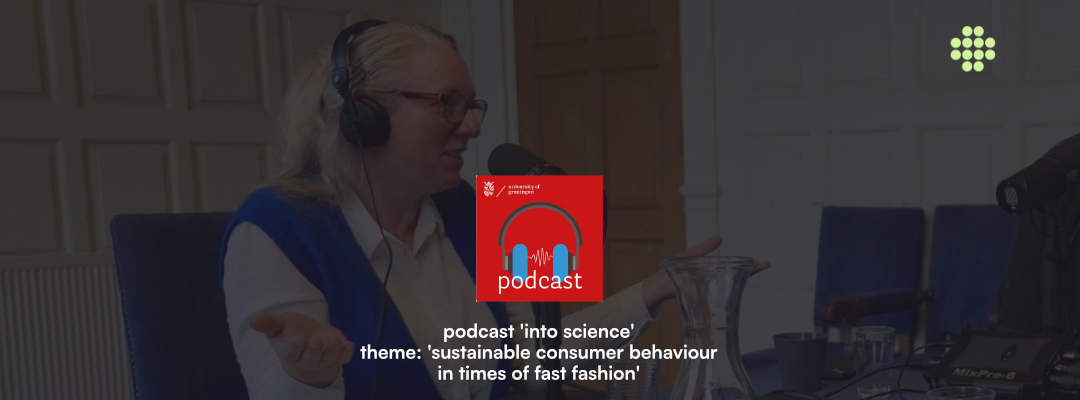
Sustainable consumer behavior under scrutiny in a new podcast with SORTED leader Marijke Leliveld
In the podcast 'In Science', Marijke Leliveld (RUG) shares insights on how consumer behavior can change in a world of fast fashion – and what that means for the future of the textile chain.